In Crystal River, "Waterfront" Is Doing Too Much Work
September 3, 2026
September 3, 2026
Pull up three different home-price trackers for Crystal River this year and you'll get three different stories. One shows the median sale price jumping more than 240 percent between March 2025 and March 2026. Another shows prices falling 12 percent over the same twelve months, as of August 2026. A third puts the typical home value essentially flat, down less than one percent year over year as of late July 2026.
These aren't rounding errors. They're the predictable result of tracking a market where only a handful of homes change hands each month. When one portal reported that 240 percent jump, it was working from ten recorded sales for the entire month. Swap two $600,000 canal estates for two $180,000 inland fixer-uppers and you can produce almost any headline number you want, without a single thing in the underlying market actually changing.
So if you're comparing Crystal River to other Citrus County waterfront towns, the citywide median is close to useless. What actually separates one Crystal River property from another isn't the headline price at all. It's a word doing far more work than it should: waterfront.
In Crystal River, "waterfront" gets stretched across at least three distinct housing products, and they don't price, insure, or live the same way.
The first is the no-bridge, deep-water canal home with a straight shot to the Gulf. Listings for these properties lean hard on that detail for a reason: plenty of Crystal River's canal network winds under fixed bridges that cap what size boat can pass, so a route with no bridges to hinder access is a specific, limited feature rather than a marketing flourish. Buyers who fish or run larger boats pay a real premium for it.
The second is the spring-fed canal tied into Kings Bay itself, the kind of property that backs onto water clarity and eelgrass beds that didn't exist fifteen years ago in some sections of the bay. More on that below, because it matters more than most buyers realize.
The third is the no-HOA canal or river-adjacent home in communities like Holiday Acres, where you trade some of the polish and amenity structure of a deeded community for lower carrying costs and fewer restrictions on how you use the property, including short-term rental flexibility that gated or HOA-governed waterfront communities often restrict.
| Waterfront Type | What You're Actually Buying | Where It Bites You |
|---|---|---|
| No-bridge, deep-water canal | Unrestricted Gulf access, boating and fishing convenience | Premium price, higher flood exposure |
| Spring-fed canal off Kings Bay | Water clarity, manatee and wildlife proximity | Tied to ongoing restoration work, values sensitive to water quality trends |
| No-HOA canal (e.g., Holiday Acres) | Lower carrying costs, rental flexibility | Fewer community amenities, self-managed maintenance |
None of these three show up separately in a citywide median. They're blended into one number that tells you almost nothing about what you'd actually be buying.
Here's the detail that gets buried under all the waterfront marketing: the City of Crystal River has confirmed that nearly all property within city limits sits inside a FEMA-designated Special Flood Hazard Area. That's not a canal-lot problem or a Kings Bay problem. It's close to a citywide baseline.
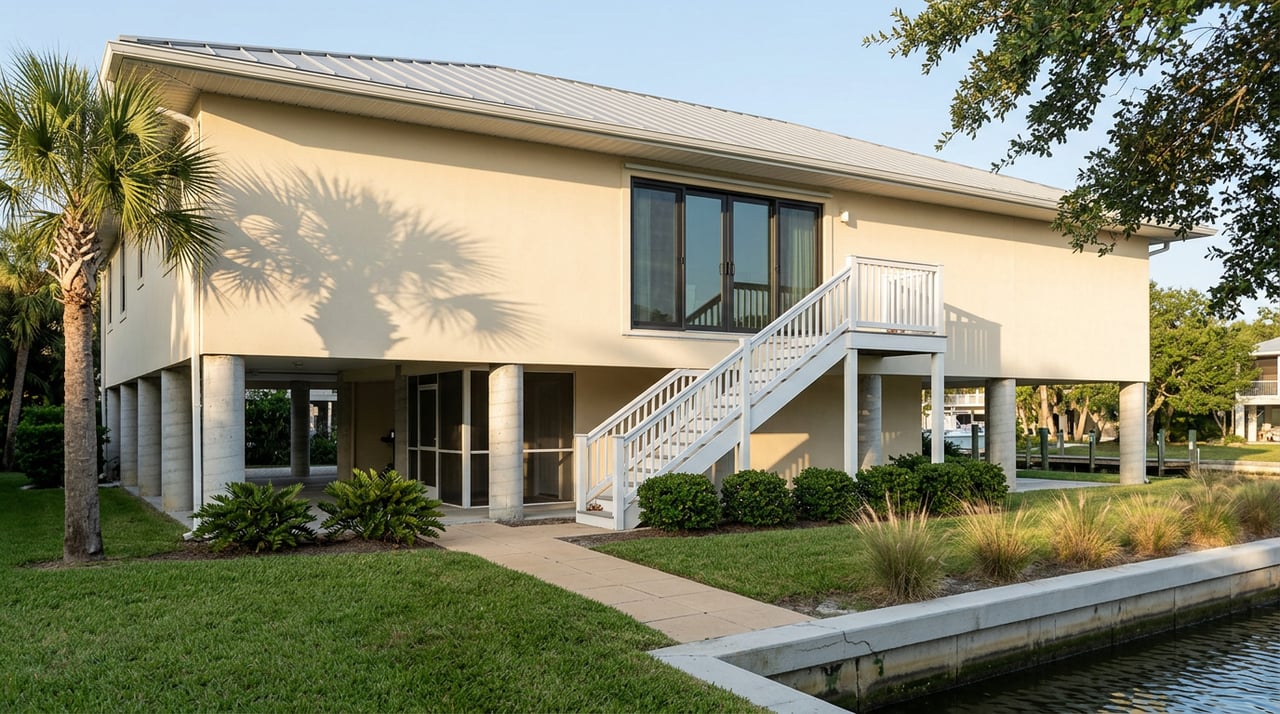
Once you accept that starting point, the question shifts from "is this home in a flood zone" to "how is this specific home built." The city requires new residential and commercial construction to be elevated at least one foot above the base flood elevation, but plenty of existing homes predate that standard or sit right at the line. Two houses on the same canal, both technically "waterfront," can carry very different insurance costs depending on whether one sits on pilings that let floodwater pass underneath and the other sits on a slab.
That distinction is about to matter more, not less. Florida's Citizens Property Insurance Corporation has been phasing in a flood insurance mandate for its policyholders since 2024: dwellings insured for $600,000 or more had to add flood coverage that year, $500,000 or more in 2025, and as of January 1, 2026, the threshold dropped to $400,000. By January 1, 2027, the requirement extends to every Citizens residential policy regardless of value or flood zone. A lot of Crystal River waterfront property falls squarely inside that $400,000-and-up band right now, which means the insurance conversation that used to be optional for some owners is becoming mandatory this year and universal next year.
If you're comparing a spring-fed canal home to a no-bridge Gulf-access home, the sale price gap might be smaller than the gap in what each one costs to insure once you factor in elevation and construction type. That's a conversation worth having with a lender and an insurance agent before you write an offer, not after.
If you're drawn to a home on a spring-fed canal near Kings Bay, there's a piece of local history worth knowing that doesn't show up in any listing description.
For decades, invasive Lyngbya algae choked large sections of Kings Bay, a problem that traced back to a 1993 storm event that pushed saltwater into the freshwater bay and killed off the native vegetation that used to hold the ecosystem together. Starting in 2015, the nonprofit Save Crystal River partnered with the restoration firm Sea & Shoreline on a phased project to dredge out the accumulated muck, replant native eelgrass, and reopen clogged spring vents. By July 2023 the project had restored its initial goal of 100 acres across five phases.
That work got a real stress test a month later. Hurricane Idalia made landfall in August 2023 and pushed a nine-foot storm surge into Crystal River, and the region went on to see five hurricanes make landfall across the Gulf in a roughly year-long stretch, three of them striking Crystal River directly. Sediment sampling done afterward found that the restored areas didn't just hold up, they showed a 25 percent reduction in fine organic muck compared to earlier benchmarks. More than 112 acres have now been replanted with over 650,000 planting units, and more than 850 natural spring vents have been reopened.
For a buyer, that history is the difference between "this canal looks clear today" and "this canal has been getting measurably clearer for a decade and held up through consecutive hurricanes." It's a reasonable factor in judging whether a spring-fed canal lot is likely to hold its appeal, separate from whatever the citywide median happens to say that month.
If you're cross-shopping Crystal River against Homosassa, Hernando, or another Citrus County waterfront market, skip the citywide median entirely. It's built on too few transactions to tell you anything reliable about a specific property type.
Instead, ask three questions about any waterfront listing you're serious about: What kind of water access is this, deep-water no-bridge, spring-fed canal, or no-HOA inland canal? What's the foundation, elevated pilings or slab, and where does that put the base flood elevation? And if you're financing through a lender who uses Citizens for wind coverage, does the dwelling value put you inside the 2026 flood mandate threshold already, or will it catch up to you by 2027 regardless?
Those three answers will tell you more about what you're actually paying for than any headline price swing will.
Does every home in Crystal River need flood insurance? Not automatically, but the city has confirmed nearly all property within its limits sits in a FEMA Special Flood Hazard Area, and federally backed mortgages typically require flood coverage in those zones regardless of what your homeowners policy includes.
When does the Citizens flood insurance mandate actually apply to me? If your dwelling coverage was $500,000 or more, it applied starting January 1, 2025. As of January 1, 2026, the threshold dropped to $400,000. By January 1, 2027, every Citizens residential wind policy will require flood coverage regardless of value.
Does an elevated foundation guarantee a lower premium? It's a major factor, since floodwater can pass beneath a home on pilings rather than through it, but the final premium also depends on your specific elevation certificate, distance to the flood source, and the home's base flood elevation relative to the required standard.
Comparing waterfront towns in Citrus County means comparing insurance math and construction type as much as it means comparing views. The Katie Spires Team walks buyers through exactly that kind of comparison, property by property, before an offer goes in. Let's make your move together.

At the Katie Spires Team, we combine deep market expertise with a client-first mindset to guide you through every step of your real estate journey. From the initial presentation to the final signature, we’re committed to making your experience seamless, strategic, and successful.
Katie Spires Team
1121 Sterling Rd Inverness FL 34450