In Citrus Springs, a Resale's Real Rival Is the New House on the Next Lot
November 5, 2026
November 5, 2026
Some Citrus Springs tax bills carry a line that has nothing to do with the value of the house. It's a water line extension assessment. Citrus County bills it to every lot sitting next to a newly installed main, and an owner can spread it over fifteen annual installments. For the district billed in 2026, that came to $3,320.08 per lot, or $357.23 a year on the property tax bill. The charge belongs to the property, not to the person who owns it. When the property sells, the seller can pay off the balance or the buyer can take over the installments.
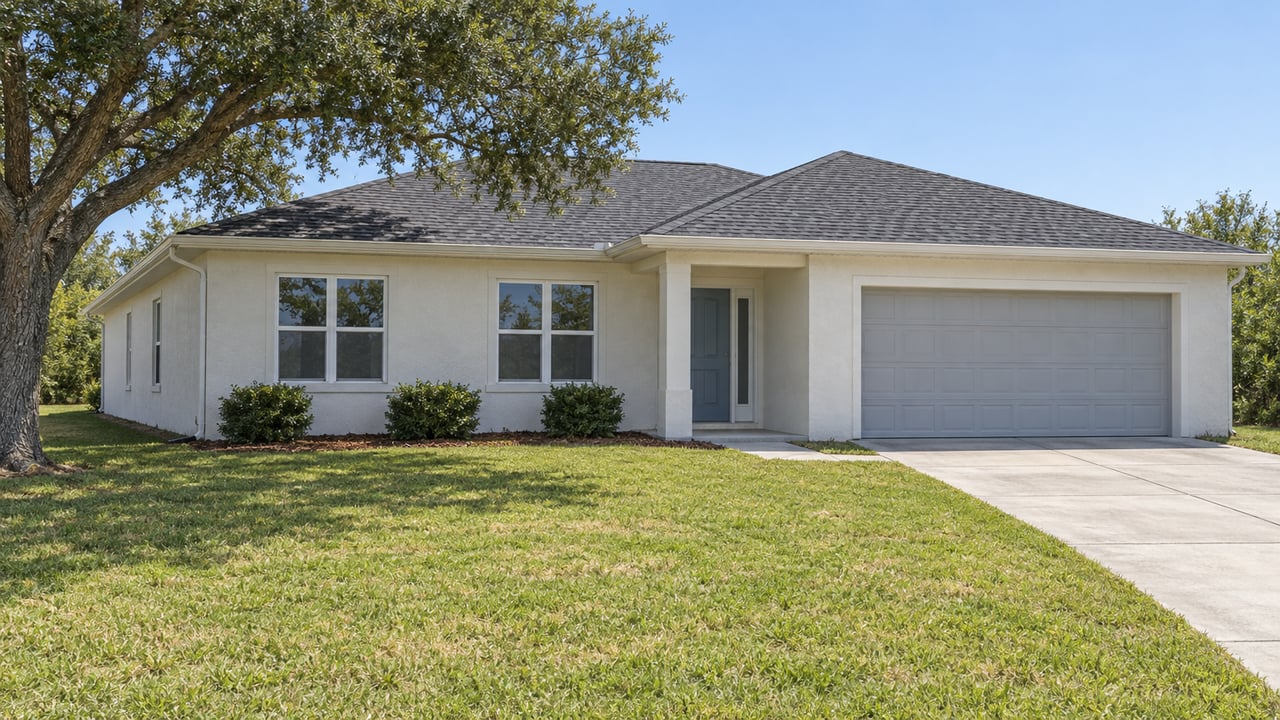
That line on the bill comes from how Citrus Springs gets built. Builders are putting new homes on lots that have been empty since the 1970s, and most of their advertised starting prices sit below the county median. County water follows that building one fiscal year at a time. Every older home for sale in Citrus Springs is competing with a brand-new house on a lot down the street. And every lot comes with a utility cost that the price alone doesn't show.
The county's own Citrus Springs water line FAQ explains the setup plainly. Every property next to water lines installed and approved during a fiscal year, October 1 to September 30, goes into that year's assessment district. The district's total cost is divided by the number of lots in it, at one lot per assessment unit. Vacant lots get billed too. The county's reasoning is that a water line in front of a lot "facilitat[es] future development."
The history of those districts tracks how busy building has been in Citrus Springs:
| Assessment district | Lots assessed | Per lot | Annual installment |
|---|---|---|---|
| 2008, covering late 2003 through Sept. 2007 | 5,518 | $1,499.54 | $161.35 |
| 2012, 2013, 2015, 2016, 2017 | No main lines installed | $0 | $0 |
| 2022 | 202 | $1,552.76 | $167.07 |
| 2023 | 520 | $2,700.73 | $290.59 |
| 2024 | 391 | $3,892.26 | $418.79 |
| 2025 | 479 | $3,732.52 | $401.60 |
| 2026 | 359 | $3,320.08 | $357.23 |
During the slow years after the housing bust, several districts had no new mains at all. Since 2023, every district has assessed hundreds of lots, and from 2024 on the per-lot cost has run more than double what the 2008 district paid.
The assessment only covers the pipe in the road. To actually get water service, the FAQ lists another $2,205 or $2,790 per standard lot at current approved rates. You pay the lower amount if the pipe is on your side of the street and the higher one if it's across the road. Put the 2026 district's assessment together with the connection fee, and a lot on a new line is looking at roughly $5,500 to $6,100 before plumbing to the house. That's our own arithmetic from the county's numbers.
The FAQ also covers some details that tend to surface in the middle of a sale:
The county also says plainly that a seller's promise of "water included" doesn't bind the county. It says it "will take many more years to complete the water lines in front of all the lots in the development." On contracts, the FAQ itself suggests talking to an experienced real estate attorney about a clause covering an assessment balance. This post is general information, not legal, tax or financial advice. Confirm the details of any specific property with the county and with the right professional.
That supply of water-ready lots is why builders keep coming back to Citrus Springs. Citrus Springs platted nearly 35,000 lots, and about 29,000 were still available, according to Habitat for Humanity's George Rusaw in a Citrus County Chronicle report. The same article reported that the county building department had issued 1,529 single-family permits and 784 certificates of occupancy in Citrus Springs over the prior two years. A local builder quoted in the story put the rise down to infill, meaning lots bought at good prices years ago that can now be built on at a profit.
The biggest single move came from CitrusCraft Homes, which is backed by the developer of the Villages of Citrus Hills. The company closed on 487 lots from The Deltona Corporation on May 23 for $10,279,900, the Chronicle reported. That works out to about $21,100 per lot. The Chronicle described the lots as large and scattered rather than grouped in a gated subdivision, connected to county water, with no HOA or CDD fees. It reported CitrusCraft homes priced from $249,990 to $300,990, including the lot and upgrades.
Other builders publish similar entry prices. Maronda Homes lists its Violet plan in Citrus Springs "from the $239s" and its Marigold "from the $254s." Holiday Builders shows a Citrus Springs "priced from" figure of $265,990.
Compare those builder prices with the county as a whole. In September 2026, the Homosassa Springs MSA, which covers all of Citrus County, posted a single-family median sale price of $279,995 on 332 closed sales, per Florida Realtors. Most of the advertised starting prices above come in below that median.
The year-to-date numbers show the effect more clearly. Through September 2026, Citrus County closed 3,265 single-family sales, up 16.6% from a year earlier. The year-to-date median was $280,995, down 0.4%. Sales jumped while the median stayed flat. That fits a market where buyers can always choose a new house at a known price, so older homes have little room to push higher. Month-to-month figures move around: August 2026 posted a $270,990 median, down 9.7% year over year. September's figures are the latest available as this post goes up. Florida Realtors' next release is scheduled for November 16, 2026.
Next door, the Ocala MSA, which covers Marion County, posted a $280,640 median for September 2026, almost the same as Citrus County. For someone weighing Citrus Springs against west Marion, the countywide medians won't decide it. The water line status of a specific street and the assessment on a specific tax bill will tell you more.
New homes are still a small share of what sells. Spectrum News reported in August 2026 that about 183 homes built in 2026 had sold countywide so far that year, out of about 2,000 total sales. It also reported roughly 1,800 homes for sale, with a large share of them new builds. As of late July, the county had issued 827 single-family permits and a little over 1,000 residential certificates of occupancy. Even so, new homes make up a large share of what's listed, and that's what sets the price comparison for resales.
Values are still rising. Citrus County Property Appraiser Cregg Dalton told Spectrum News that Citrus Springs is "a high desirable market" where values are increasing, "not so much skyrocketing, but they're just higher." The same report cites the Florida Department of Revenue: Citrus County has more than 54,000 vacant residential parcels, the fourth-highest total in the state.
So prices here climb steadily, without jumps, because new homes keep coming on and set a ceiling.
For a seller with an older Citrus Springs home, the main competition is the nearest new build and its price, finishes and warranty, more than other resales. A resale that already has water service may have one real edge. A buyer looking at a new-line lot is facing the assessment, a connection fee of $2,205 or $2,790 and the plumbing on top. Existing customers who have already paid their connection fees aren't billed for the assessment retroactively, according to the county.
For a buyer comparing a new house with a resale, look at the tax bill as well as the price. A remaining installment balance follows the property. A vacant lot may sit on a street the county hasn't reached yet, or on one where the pipe runs on the far side of the road.
Does every Citrus Springs lot have county water? No. The county says completing lines in front of every lot will take many more years.
Who pays a remaining assessment when a home sells? The assessment is attached to the property. The seller may pay it off with no prepayment penalty, or the buyer may take over the annual installments.
What if an original deed lists a utility prepayment? The county will apply a documented Deltona-era prepayment to connection fees, not to the assessment.
If you're pricing a Citrus Springs home against the new builds nearby, or weighing a lot where the water line is still years away, the Katie Spires Team can help you compare the full cost side by side. Let's make your move together.

At the Katie Spires Team, we combine deep market expertise with a client-first mindset to guide you through every step of your real estate journey. From the initial presentation to the final signature, we’re committed to making your experience seamless, strategic, and successful.
Katie Spires Team
1121 Sterling Rd Inverness FL 34450